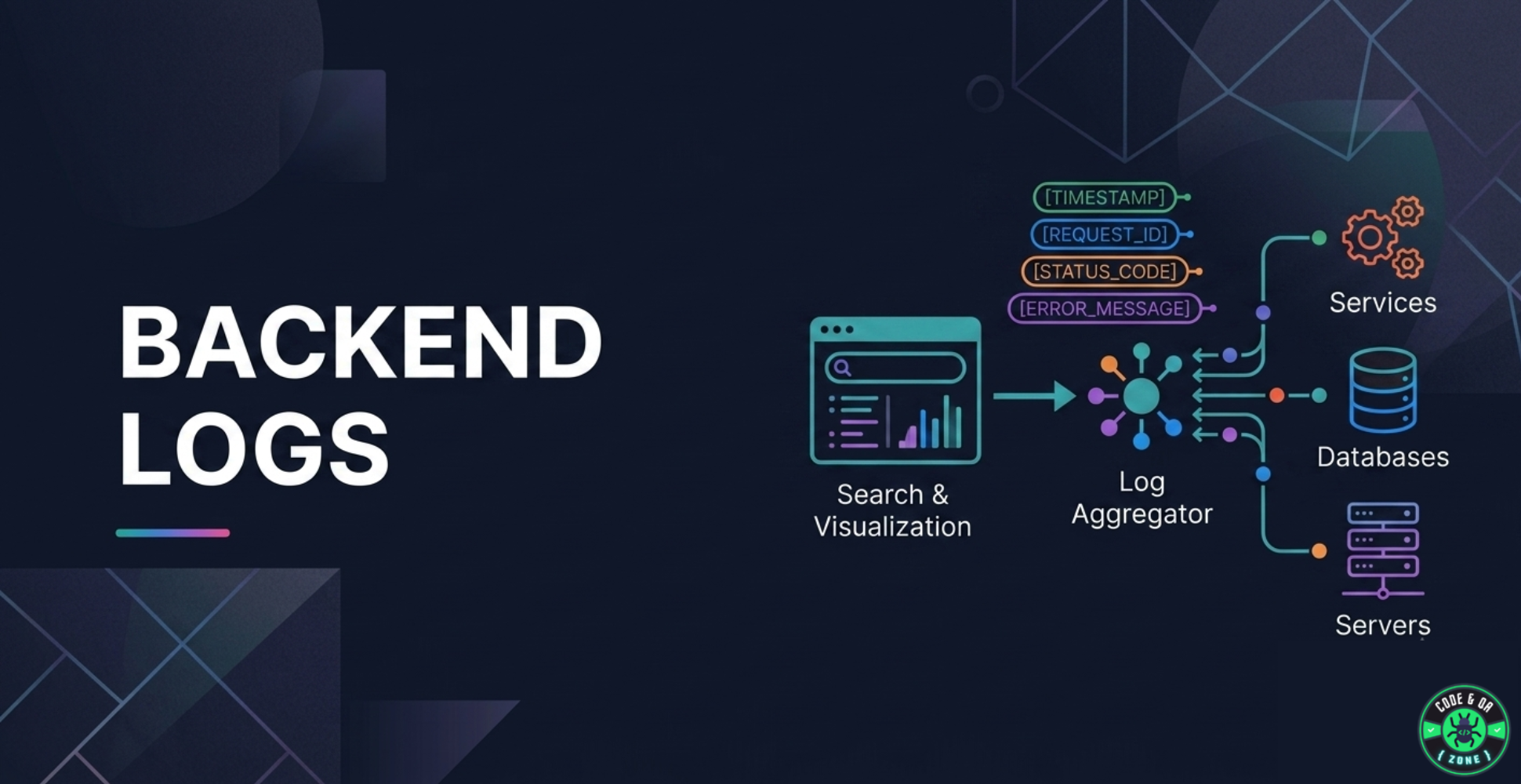
What Are Backend Logs and Why Should Software Testers Care?
- 30 Jun 2026
When testing an application, most of our attention is focused on what we can see: API responses, user interfaces, database records, and error messages.
But what happens behind the scenes after a request reaches the backend?
That's where backend logs come in.
While users only see the final outcome of an operation, logs provide a record of what happened inside the application while that operation was being processed. Understanding the basics of logging can help testers investigate issues faster, write better bug reports, and gain a deeper understanding of how systems behave in production.
What Are Backend Logs?
Backend logs are records of events that occur while an application is running.
Whenever a backend service receives a request, processes data, communicates with another system, encounters an error, or completes an important operation, it may write information to a log.
For example:
2026-06-17 10:30:15 UserService - User 1234 successfully authenticated
Or:
2026-06-17 10:31:02 PaymentService - Payment transaction failed for Order 9876
You can think of logs as a timeline of events that helps teams understand what the application was doing at a specific moment in time.
A common misconception is that logs only exist to record errors. In reality, many logs capture normal application activity and important business events as well.
Why Applications Generate Logs
Applications generate logs to provide visibility into what is happening inside the system.
When an application is running in production, developers and testers cannot observe every request in real time. Logs create a historical record that can be reviewed whenever questions arise.
Common reasons for logging include:
- Recording incoming requests
- Tracking important business events
- Capturing failures and exceptions
- Monitoring application behavior
- Supporting troubleshooting and debugging
Let's see an example:
Consider an e-commerce application where the customer reports that they were charged twice for a purchase.
Without logs, the team might struggle to determine what happened.
With logs, they may be able to reconstruct the sequence of events and identify where the problem occurred.
This ability to reconstruct events is one of the primary reasons logging is considered essential in modern applications.
Backend Logs vs API Responses
One of the most important concepts for testers is understanding the difference between an API response and a log entry.
An API response is what the client receives.
For example:
{
  "error": "User not found"
}
This tells us that the request failed. However, it doesn't tell us why.
The backend log may contain additional details:
2026-06-17 10:30:15 UserService - User ID 1234 not found in database
Or:
2026-06-17 10:30:15 DatabaseConnection - Connection timeout while querying users table
The difference is simple:
- API responses tell us what happened.
- Logs often help explain why it happened.
This distinction becomes especially important when investigating defects because the root cause of a problem is often hidden from clients for security and usability reasons.
How Logs Help QA Investigate Issues
Imagine you're testing an endpoint that creates a new user.
Expected result:
201 Created
Actual result:
500 Internal Server Error
Without logs, you only know that the request failed.
With access to the backend logs, you might find:
Database timeout while inserting user record
That single log entry immediately provides useful context.
You now know:
- The request reached the backend.
- Validation likely succeeded.
- The failure occurred while communicating with the database.
Logs can help answer questions such as:
- Did the request reach the backend?
- Which operation failed?
- Was another service involved?
- Did the application throw an exception?
- Is the issue occurring in the frontend or backend?
Even when QA is not responsible for fixing the problem, this information can significantly improve bug reports and reduce the time required for developers to identify the root cause.
Final Thoughts
Backend logs are one of the most valuable tools for understanding how an application behaves.
While API responses show the outcome of a request, logs provide visibility into what happened inside the system and often reveal why something failed.
For testers, learning how to read and interpret logs can lead to:
- Faster investigations
- Better bug reports
- More productive conversations with developers
- A deeper understanding of system behavior
Happy testing!